Act 1
This page details the creative choices made in the process of the first 5 minutes in the 15 minute composition and contains character building audio. By placing the listener in the shoes of a protagonist, the initial imagination of a game world can be formed and this allows the subsequent acts to be produced around this critically important aspect of video game sound design.
Foley Workshops
To begin the project, I booked studio time in 3 different spaces in order to pick up several different captures of Foley footsteps. This way there was a large variety of different sonic textures picked up and the decision could then be made which had the greatest quality and would then be used within the final mix. Firstly, I had recorded the steps with my hand banging against the material at a small distance from the microphone. After the first session, I reviewed the audio which was recorded, and wasn't entirely satisfied with how the steps sounded due to subtle reflective room noise interference captured with the cardoid polar pattern on the AKG C414 microphone, so the next session was booked immediately with the intention of using a much more optimal space and a Rode NTG2 shotgun mic, which would be much more beneficial to remove unwanted noise.
The next session was booked in a much more optimal space with a higher quality of acoustic treatment, and the audio captured worked much better... Or so I thought at the time. The audio captured here was used in the initial mix for the next steps but further on in the project session I had come to the decision that other choices had to be made to increase the immersive realism of a the audio coming from a character within a video game world. This will be touched on later in the timeline of the project.

Second recording session with the NTG2 microphone.

Chosen space with optimal acoustic treatment.
The Generative Rhythm of Movement
In order to maintain the idea of video game character sound, the first step of this process was to gather the Foley recordings taken, place them into an Ableton Live session and build a Generative audio track with each chosen material. With the parameters set for each recording to happen at about a 60-80% chance of following the previous footstep, this ensures that the chance of the same two footsteps following after one another is low. After generating around 17/18 minutes worth of these footsteps, the next step was to decide sections where the terrain material would switch, even further enhancing the variety in steps made. Initially the tracks for each material had been automated to mute the track allowing for the one chosen as the centre piece in their moment however, I quickly realised that the switch in tonality between these steps created a gulf in quality for the piece. It was then I decided to maintain the 'concrete' material track as a constant throughout, but used automation to lower the amplitude where other terrain steps were to be the indicator of a switch in the characters zone.
Once the track had been generated and each material chosen for their respective period of time, a tempo was set to the session to allow for a rhythmically consistent flow of footsteps. This was set at around the same pace as the orchestral score in Act 2, however this proved to be detrimental to the composition and after discussing the piece as it stood at the time with my supervisor, we both agreed that the footsteps seemed to sound more like a percussive addition to the music rather than a character traversing through a game world. This prompted me to include some automation in the tempo to allow for an even bigger variety in sonic value and breaking away from being rhythmic with the rest of the elements included in the project.
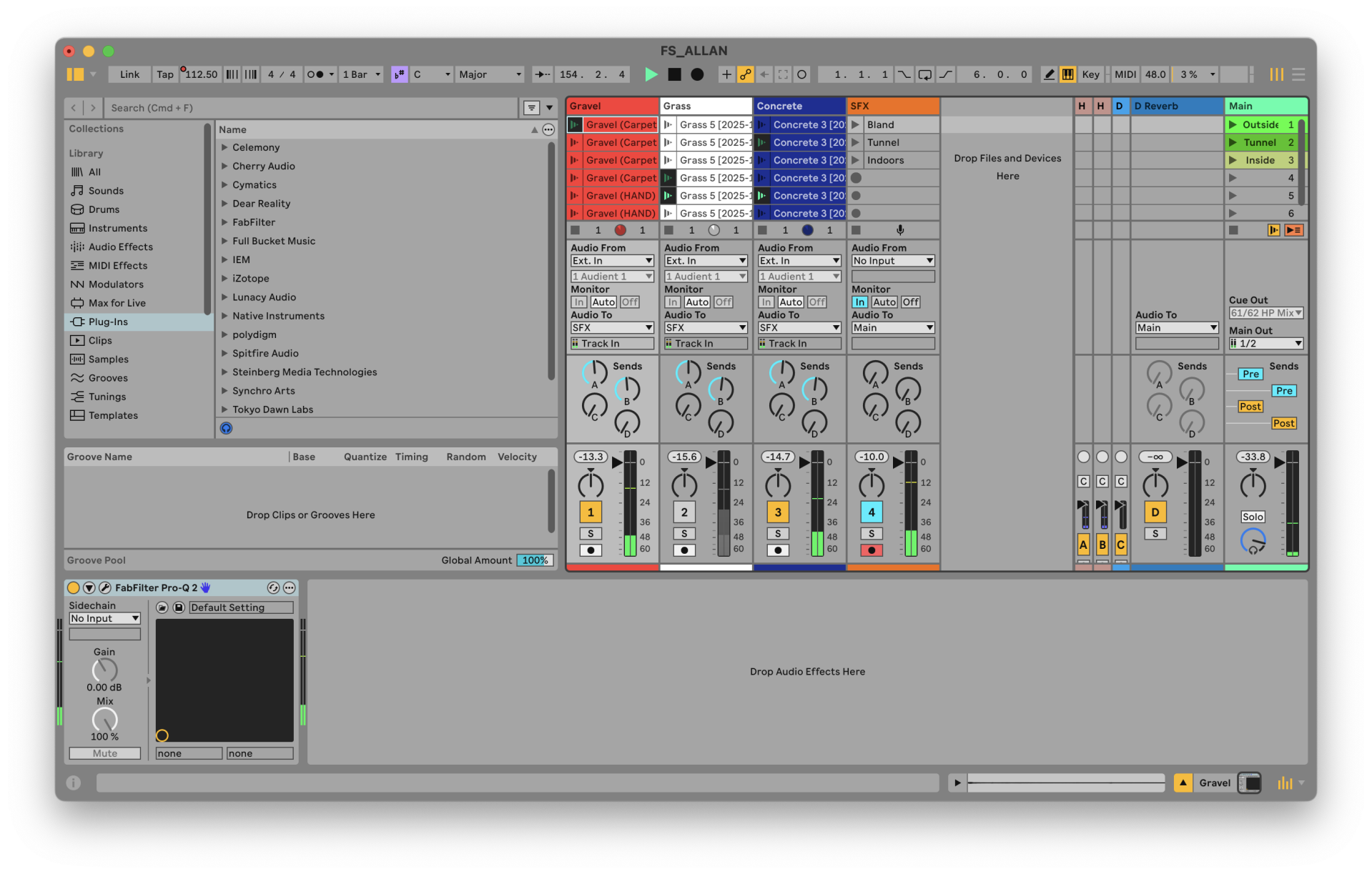
Generative audio session.

Tempo automation on main bus timeline.
Final Foley Workshop
This recording session was organised with the sole intention of recording general character movements. To do this, I brought in a large parka jacket with screws in the pocket, shook it in front of the microphone to simulate the sound of a video game characters gear/backpack. I generated a track similarly to the footsteps tracks however, the variety proved to be too diverse and the audio didn't blend very well with the footsteps. I made the decision then to just use two and automate the transposition for the clothing to ensure there was variety, but the sound was consistent along to align with the footsteps.
A compressor with a side-chain linked to the footstep audio bus was implemented, this was to duck the fabric audio with footstep impacts. This blended both audio tracks together well and created the proper sense of movement that you would hear in a video game world.

Transposition automation on clothing clip.

Side chain MB compressor to duck clothing audio with footsteps impact.
Below is the 5 minute excerpt of Act 1 to listen to. (NOT ADDED YET)
Please click the link above to be taken to the next page to continue on to the next process of the piece.